Marketing Data Management: How to Turn Scattered Campaign Data Into Decisions
Last updated:
ShortPen University


LucaG is the co-founder of ShortPen. Before that, he built Guadagnissimo from scratch, a personal finance blog that reached hundreds of thousands of readers per year and was later acquired. That experience is where he learned SEO and marketing attribution hands-on. He also runs NTSOT, a newsletter on tools for work and life. His background spans product design, growth, and building online businesses.
Show more
Marketing data management is the process of collecting, cleaning, organizing, and using marketing data so it stays accurate enough to act on.
Most teams don't struggle because they have too little data.
They struggle because they have too much of it, spread across ad platforms, an email tool, a CRM, web analytics, and whatever tracks their links and QR codes. None of it lines up.
So when someone asks which campaign drove last month's signups, the honest answer is a guess.
This guide covers what marketing data management is, the components that make it work, where campaign data tends to break, and how to run it without an enterprise data team behind you. It's written for the marketer who owns campaigns and reporting, not the data engineer who owns the warehouse.
What is marketing data management?
Marketing data management is the practice of gathering marketing data from every channel, cleaning it, storing it in one place, and keeping it accurate so teams can measure performance and make decisions.
It covers the full path of a data point: collection, cleaning, storage, analysis, and governance.
The term gets confused with two others, so it's worth separating them.
Master data management (MDM) is an enterprise discipline for maintaining a single authoritative record of core business entities like customers, products, and suppliers across every system in a company. It's broader than marketing and usually owned by IT.
Data management platforms (DMPs) are ad-tech tools built mainly around third-party audience data for ad targeting. Their relevance has faded as third-party data has become harder to use.
Marketing data management sits between the two. It's marketing-owned, focused on campaign and customer data, and practical rather than infrastructural.
The types of marketing data
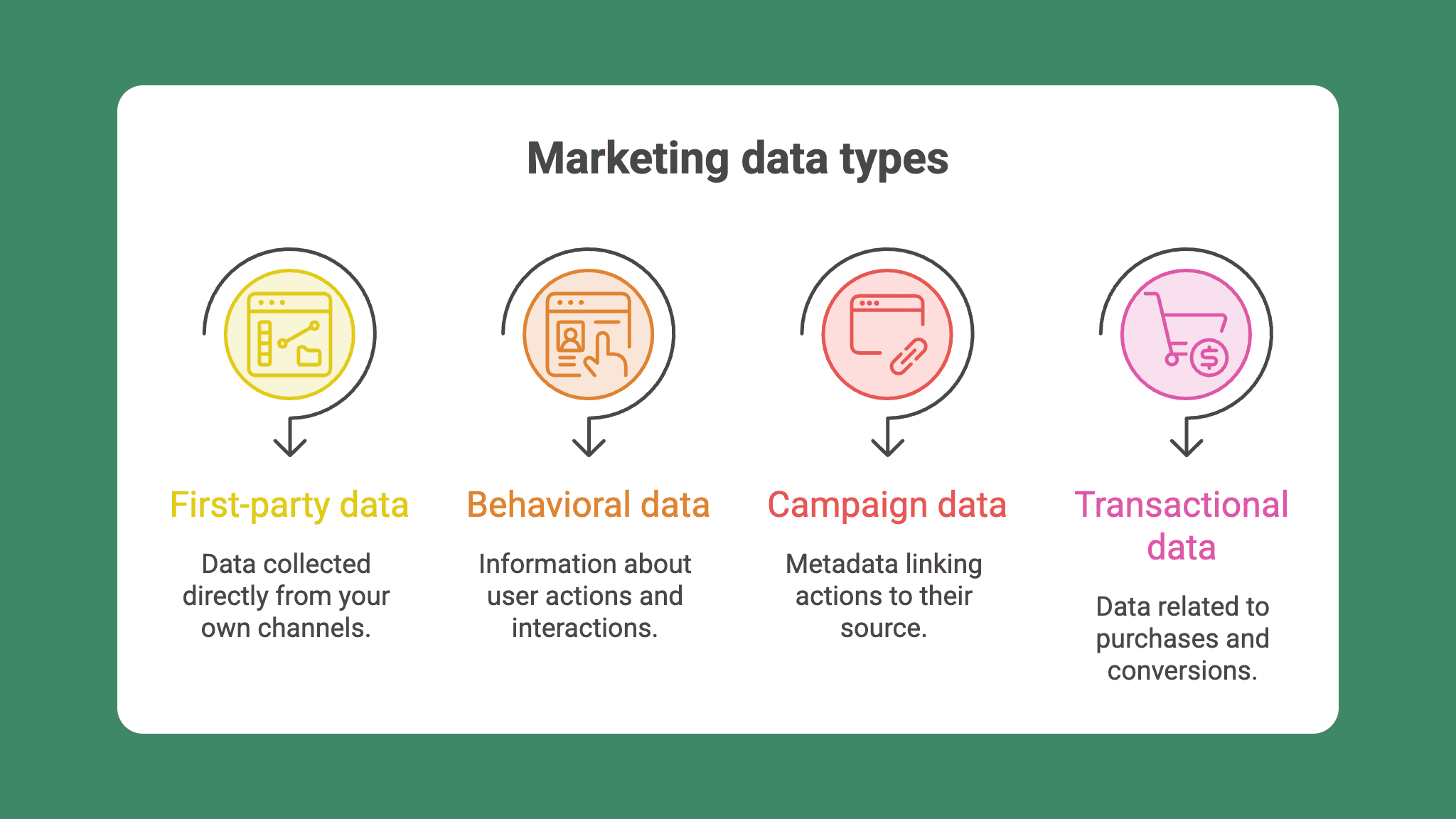
Most marketing data falls into a few buckets.
First-party data comes from your own channels: website, app, email list, and CRM.
Behavioral data is what people do, like clicks, scans, page views, and sessions.
Campaign data is the metadata that ties an action to a source, such as UTM tags and referrers.
Transactional data is purchases, signups, and other conversions.
Managing marketing data well means keeping these connected instead of trapped in separate tools.
Why marketing data management matters now
Good data management is what separates teams that can attribute revenue to specific campaigns from teams that guess. When your email platform, ad accounts, and link tracking don't share a common structure, you can't measure cross-channel impact or calculate real return. You end up defending budgets with numbers you don't fully trust.
The privacy story also changed, and a lot of published advice is now wrong about it. For years, articles warned that third-party cookies were about to disappear. That deprecation is off.
Google dropped its plan to phase out third-party cookies in Chrome in April 2025, and in October 2025 it retired the remaining Privacy Sandbox APIs, ending the initiative entirely, as Adweek confirmed. Third-party cookies stay in Chrome for now.
That does not make privacy work optional. GDPR and CCPA still apply in full, data privacy regulations still shape how teams collect, store, and govern customer information, users still block and delete cookies, and first-party data is still the most reliable foundation you control, providing 70% more accurate insights than third-party data.
The point is simpler than the old panic suggested: own your data, collect it with consent, build around data privacy, and stop depending on signals that browsers or vendors can pull at any time.
The core components of a marketing data management system
A working system has five parts. You don't need heavy tooling for each one, but you can't skip any of them without paying for it later in bad reports.
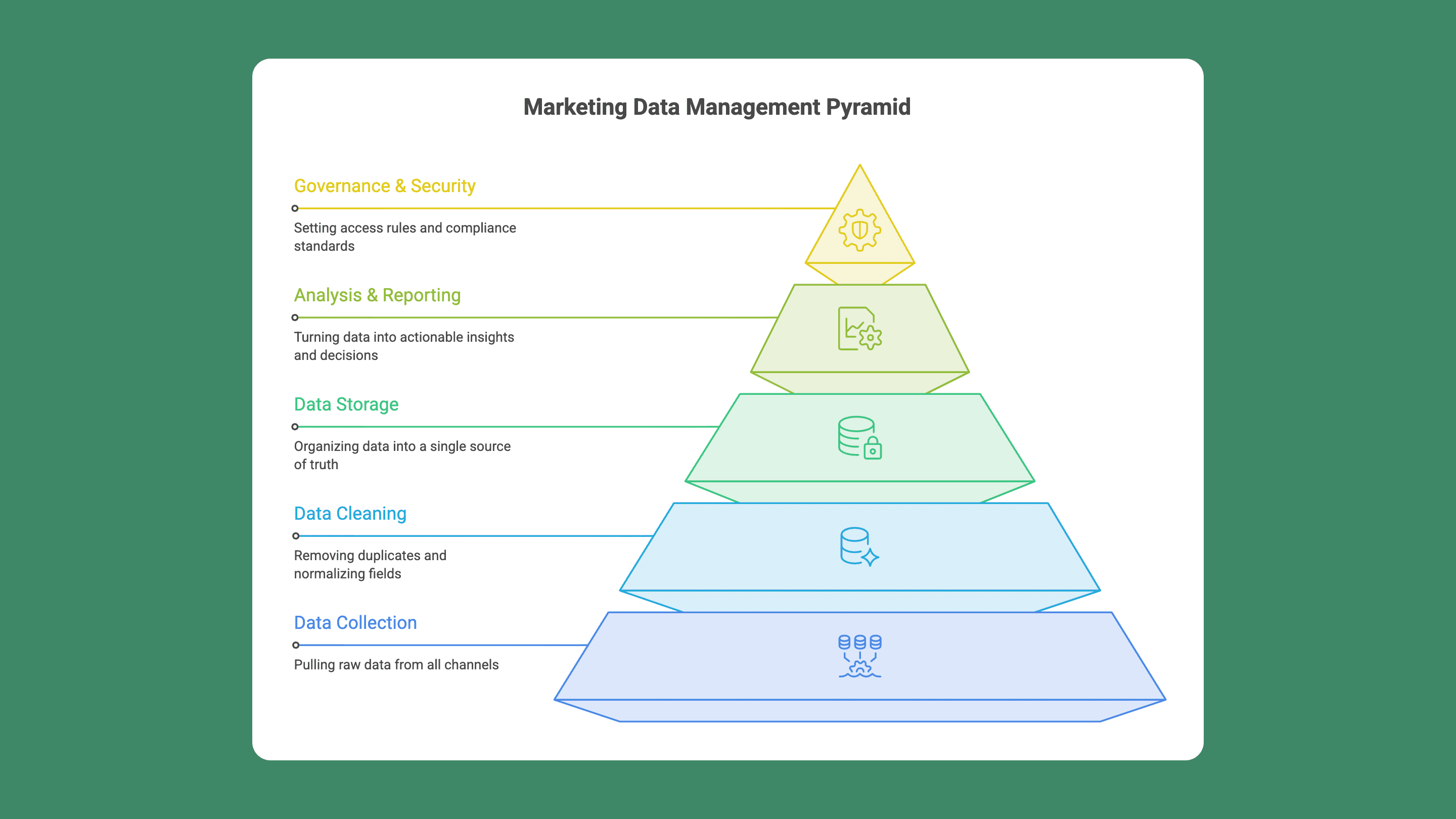
Data collection and integration
This is pulling raw data from every channel into one place. For a lean team, that might be scheduled exports into a spreadsheet or a connector tool. For a larger team, it's pipelines feeding a warehouse. The goal is the same: get channel data out of its silo and into a shared structure where fields line up.
Data cleaning and validation
Raw marketing data is messy. Duplicates, inconsistent formats, and mislabeled sources all creep in. Cleaning removes duplicate records, normalizes fields so Facebook, facebook, and FB become one value, and enforces rules that catch errors before they reach a dashboard. Dirty data doesn't just waste time. It produces confident, wrong conclusions.
Data storage and organization
Managed data needs a home for storing data and organizing data so it acts as the single source of truth. At small scale, that's a well-structured spreadsheet or a lightweight database.
At larger scale, it's a data warehouse or one of the data lakes teams use to consolidate varied sources.
What matters is that one centralized place holds the version everyone trusts, which improves data integrity, instead of five tools each holding a different number. Centralized systems also strengthen security management.
Analysis and reporting
Storage isn't the point. Decisions are. This component turns rows into answers: which channels drive conversions, which segments respond, where spend is working. Analysis can happen in a BI tool, a warehouse query, or a reporting dashboard, depending on your stack.
Governance and security
Governance sets who can access data, how long you keep it, and how you stay compliant. It sounds like overhead, and it partly is, but it's also where you decide what you should and shouldn't collect. Less unnecessary data means less risk and cleaner reports.
Where campaign data actually breaks (and how to fix it)
Most guides jump straight from "collect your data" to "put it in a warehouse." They skip the place campaign data usually goes wrong, which is the link itself. If the data is dirty when it's created, no amount of downstream cleaning fully saves it.
Three break points cause most of the damage.
Inconsistent UTM tags at creation. UTM parameters are how you attribute traffic to a source, medium, and campaign. When people build them by hand, you get utm_source=newsletter, utm_source=Newsletter, and utm_source=email-newsletter all pointing at the same channel. Your reporting then splits one channel into three, and the numbers stop meaning anything.
Siloed click and scan data. A single campaign often runs across a QR code on a poster, a link in an SMS, and a link in a social post. When each lives in a different tool, you can't see the campaign as one thing. You see fragments. Across multiple channels, that fragmentation makes it harder to reconstruct the customer journey.
The click-to-conversion gap. Standard link tracking tells you something was clicked. It doesn't tell you whether that click became a signup or a sale. Without connecting the click to the outcome, you're optimizing for traffic instead of results.
The fix is to standardize before you centralize, so data quality issues get reduced before they spread downstream. If every link is built the same way, with consistent tags and one place to read the data, it enters your reporting clean.
This is where a link management layer earns its place. With ShortPen, you create branded short links on your own domain and build UTM parameters with a structured builder instead of free text, so tagging stays consistent across everyone on the team.
Every link and every QR code tracks clicks and scans automatically, broken out by location, device, and referrer, with no pixel required for that basic layer. You can test this on the free plan, which includes unlimited links, unlimited clicks, QR codes, and one custom domain.
Common marketing data management challenges
Every team hits the same short list of problems. Naming them makes them easier to plan around.
Data silos. Channel tools don't talk to each other by default. The fix is a deliberate integration step that lands everything in one structure.
Data quality and decay. Contact and behavioral data goes stale. People change jobs, emails bounce, and sources get mislabeled. Regular validation and clear naming conventions slow the decay.
Integration friction. Connecting a CRM, ad platforms, email, and analytics takes real effort, and APIs change. Connector tools or a small amount of engineering handle most of it.
Privacy and compliance. GDPR and CCPA set rules for consent, storage, and deletion. Building consent and data minimization into your process from the start is cheaper than retrofitting it after a complaint.
Scale. A spreadsheet that works at a thousand records breaks at a million. Plan the next tier of tooling before you're forced into it, not during a crisis.
Best practices for managing marketing data
You can run effective marketing data management with a small team if you're disciplined about a few habits.
Standardize at the source. Agree on naming conventions and UTM templates before a campaign launches. Consistency at creation prevents most cleaning work later.
Unify into one source of truth. Pick the one place your team trusts for numbers, and route all the data there. Kill the habit of pulling the same metric from three tools.
Automate collection and cleaning. Manual exports are error-prone and don't scale. Move repeatable data management processes and data processing to scheduled jobs or connectors as soon as the volume justifies it.
Govern access and retention. Decide who can see and edit what, and how long you keep data. Collect what you'll use, not everything you can.
Measure conversions, not just clicks. Traffic is a vanity number until you tie it to outcomes. This is the habit most teams skip, and it's the one that changes decisions by supporting targeted campaigns, and personalized marketing can boost conversion rates by up to 10%. Better data also improves campaign performance, and effective data management can reduce marketing costs by 30%.
That last habit is where post-click tracking matters.
With ShortPen, you install the ShortPen Pixel on your site once, then define the events you care about, such as signups, purchases, or form submissions, directly from the dashboard.
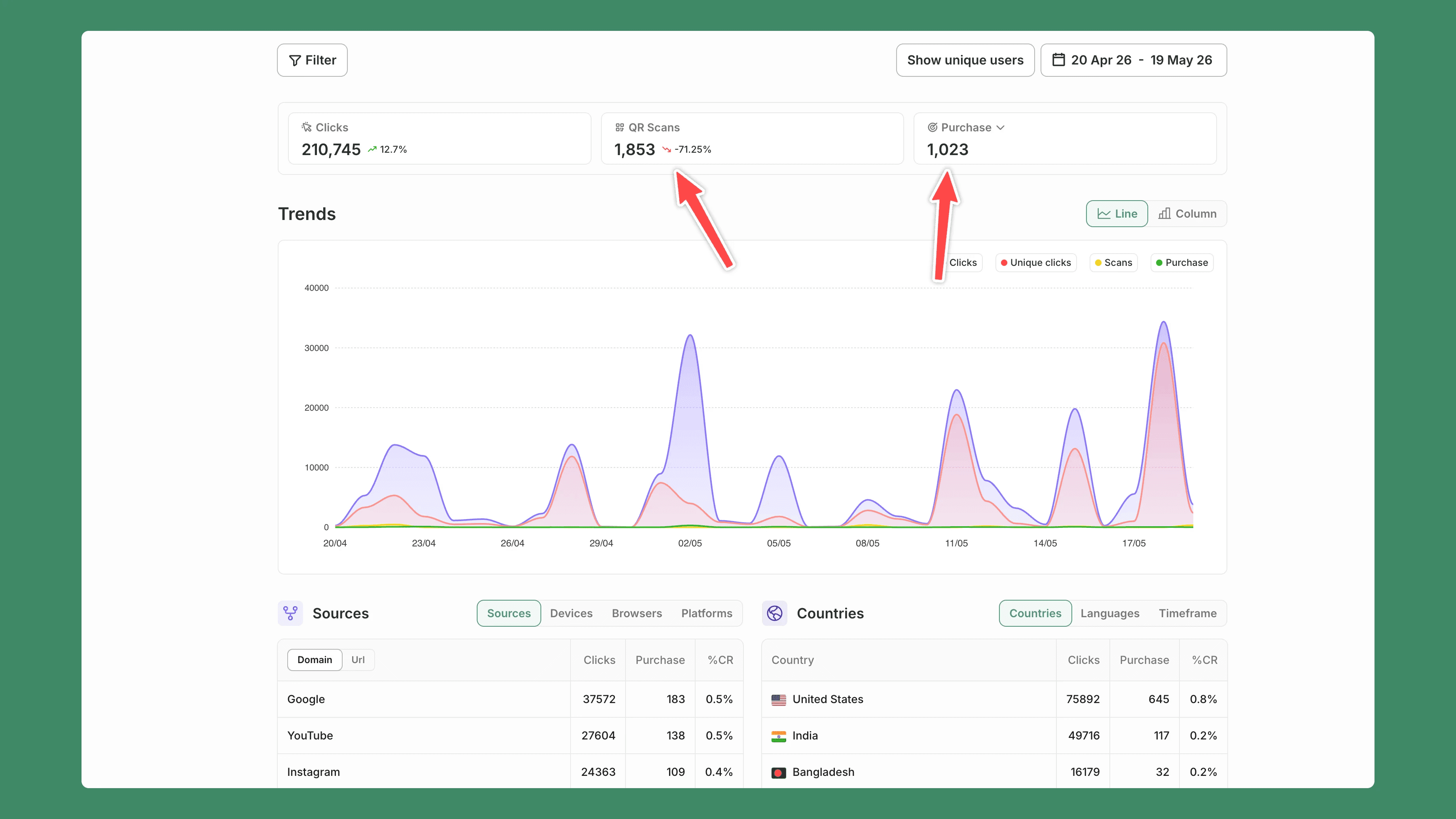
You enable event tracking on the specific links you want to measure, and conversions attribute back to the original click or QR scan. For Shopify stores, integration events like Add to Cart, Checkout, and Purchase map automatically.
Events aren't retroactive, so you set them up before a campaign runs, not after.
For organization, workspaces and folders keep each campaign's links and their data grouped instead of scattered across one long list. That structure is part of data management too, since it decides how easily you can find and read a campaign's numbers weeks later.
Marketing data management tools, and where each fits
There's no single tool that does all of marketing data management. The practical move is to make tool selection part of a broader management strategy, matching each job to the right category rather than hunt for one platform that claims to do everything.
Link management (ShortPen, Bitly, Rebrandly, Short.io, Dub): the layer that captures clean, attributable click and scan data at the point of creation, before it ever reaches a warehouse. This is where UTM consistency and click-to-conversion tracking live.
Customer data platforms (Segment, Tealium): unify customer data from multiple touchpoints into a single identity, giving teams a clearer view of the customer journey.
Data warehouses (Snowflake, BigQuery): central storage for teams with enough volume and engineering to run them, and the place where shared data assets can be queried and reported on.
CRMs (Salesforce, HubSpot): the record of customers, deals, and pipeline.
BI tools (Looker, Power BI): the analysis and reporting surface on top of stored data.
Smaller teams often don't need a warehouse or a CDP at all. A link management tool, a CRM, and a reporting view can cover most of what they need until scale forces an upgrade.
For technical teams: automating the data layer
If you have engineering support, the link layer can run programmatically. ShortPen's REST API and webhooks are key features for technical teams using data management software, letting you create links in code with custom slugs, folder assignment, UTM injection, redirect control, and password protection so link generation fits inside an existing workflow instead of a manual dashboard step.
Webhooks can push event data to your own systems as it happens, which helps with integration data collection as events move into downstream tools. API access and webhooks are on the paid plans, which start with a 14-day premium trial if you want to test the integration before committing.
ShortPen is EU-hosted and GDPR-native, with cookieless analytics and no personally identifiable information stored, which helps protect sensitive data and support secure data access without creating major consent-banner complexity.
FAQ
What is marketing data management in simple terms?
It's how you keep your marketing data accurate and usable. You collect data from every channel, clean it, store it in one trusted place, and use it to measure what's working. Done well, it lets you attribute results to campaigns instead of guessing.
What is the difference between marketing data management and master data management (MDM)?
Marketing data management is marketing-owned and focused on campaign and customer data. Master data management is a broader, IT-owned discipline that maintains a single authoritative record of core business entities like customers and products across every system in a company. They overlap, but they solve different problems at different scales.
Do small teams need a CDP or a data warehouse to manage marketing data?
Usually not at first. A structured spreadsheet or lightweight database, a CRM, and a link management tool cover most needs for a lean team. A customer data platform or warehouse becomes worthwhile once data volume and channel complexity outgrow simpler tools.
How do you track conversions, not just clicks, from a marketing link or QR code?
You need a tracking pixel plus event definitions. With ShortPen, you install the ShortPen Pixel once, create events like signups or purchases from the dashboard, and enable event tracking on the links you want to measure. Conversions then attribute back to the original click or scan.
Are third-party cookies still a concern for marketing data in 2026?
Less than the old advice suggested. Google canceled its cookie phase-out and shut down the Privacy Sandbox in October 2025, so third-party cookies remain in Chrome. Consent compliance under GDPR and CCPA still applies, and first-party data is still the most reliable foundation to build on.
What data should marketers stop collecting?
Anything you don't use and can't justify keeping. Extra fields you never analyze add compliance risk and clutter your reports without improving decisions. Data minimization is both a privacy practice and a way to keep your datasets clean.
Conclusion
Marketing data management comes down to making your campaign data trustworthy before you try to act on it. The cheapest place to start is where the data is created, which means standardizing how links are built and tracked so every number that reaches your reports is clean and attributable.
Pick one active campaign and tighten it end to end: consistent UTMs, one place to read the clicks and scans, and conversion tracking tied to real outcomes. Once that works, expand the same discipline across your channels. You can set up the link and tracking layer for free and grow from there.
Ready to make every click count?
Simplify your link management, gain valuable insights, and take control of your online presence. Your journey to better links starts here.