QR Code Marketing Strategy: How to Plan, Run, and Measure Campaigns that Convert
Last updated:
ShortPen University


LucaG is the co-founder of ShortPen. Before that, he built Guadagnissimo from scratch, a personal finance blog that reached hundreds of thousands of readers per year and was later acquired. That experience is where he learned SEO and marketing attribution hands-on. He also runs NTSOT, a newsletter on tools for work and life. His background spans product design, growth, and building online businesses.
Show more
A QR code marketing strategy is the plan that connects a scan to an outcome you can name, such as a signup, a purchase or a booked demo. It has three parts: one goal per code, a design and placement that earn the scan, and tracking that follows the scan to the conversion.
Most QR campaigns count scans and stop there. The poster goes up, the scans roll in, and the report says "4,200 scans" without ever answering the real question: what was a scan worth?
Only 16% of marketers tie QR codes directly to revenue, and 87% say they struggle to understand what happens after someone scans (Bitly, 2025 QR Code Survey).
That gap is the difference between a QR code that looks busy and one that earns its place in the budget.
A scan is the start of the funnel, not the finish line.
A qr code marketing strategy is the plan that connects that scan to an outcome you can name, like a signup, a purchase, or a booked demo.
This guide covers the three parts that make a campaign work: planning frameworks, the design and placement that earn the scan, and the measurement that proves the conversion. It also covers something most guides skip, which is where QR codes are the wrong tool entirely.
What a QR code marketing strategy actually is

A QR code marketing strategy is a plan for using QR codes as a measurable bridge from an offline or physical touchpoint to a specific digital action, with deliberate choices about the destination, the call to action, and how you measure the result.
Put plainly: a QR code without a strategy is just a printed square. What turns it into a marketing channel is the chain behind it, goal to destination to CTA to measurement.
The timing is good. 93% of marketers increased their QR usage in the past year, 98% report a positive impact, and Statista projects 102.6 million US smartphone users will scan a QR code in 2026.
Adoption is rising, scanning is a normal habit, and native phone cameras have read codes without a separate app since 2017. The opportunity is not whether people will scan.
It is whether you can turn the scan into something measurable.
Static vs dynamic QR codes

A static QR code encodes the destination directly, so it cannot be edited or tracked after you print it.
A dynamic QR code points to a short redirect you control, which means you can change the destination later, run A/B tests, and record every scan.
For marketing, dynamic is the default. Some platforms make every code dynamic by design.
ShortPen does, so you can update where a printed code points without reprinting it, as long as the link's domain and slug stay the same.
Start with the goal, not the code
Strong campaigns start from a single measurable objective and work backward to the code as one tool within broader marketing strategies. The objective decides the code type, the destination, and the metric you will judge success by.
Here is a five-step planning spine that helps fit QR use into the wider marketing mix and the realities of modern marketing. The first four steps are familiar. The fifth is where most strategies fall short.
Define one measurable objective. Signups, purchases, app installs, leads, or reviews. Pick one per code.
Choose a dynamic, branded code. Editable destination, scan analytics, room to test.
Design for scannability and trust. A code that fails to scan or looks sketchy never gets the chance to convert.
Place where intent is highest. Match the placement to where the person is in their decision when incorporating qr codes into broader marketing campaigns.
Measure the conversion, not just the scan. Track the scan all the way to the outcome you defined in step one.
Match the campaign to intent
Placement and message should match the intent of the person who sees the code, including where it can connect physical and digital touchpoints at the right moment across the customer journey.
A useful way to plan this is an intent portfolio, an idea drawn from Branch's work on QR strategy.
It sorts campaigns into three buckets. QR codes work best when they provide instant and frictionless brand interaction tied to user intent, improving the customer experience.
Passive, low intent. Billboards, TV, broad print. Wide reach, low activation. An incentive helps lift it.
Active, medium intent. In-store signage and posters where customers already are. Smaller audience, higher engagement, because these people already chose to be near your brand.
Active, high intent. Receipts, packaging inserts, one-to-one touchpoints. The smallest audience and the highest conversion, because the moment is personal and timely.
Placement determines scan rate more than almost any other variable, so this is not a detail to leave to chance.
Design and placement: Getting the scan
Before a code can convert, it has to scan reliably and earn a tap. This part is well understood, so the goal is to get the specifics right and move on.
Design for scannability

Keep contrast high, at least 3:1 and ideally 4:1 or better, with dark modules on a light background, so the code stays easy to scan on different mobile phones through standard phone cameras. Never invert to light-on-dark, which trips many scanners.
Size the code using the 10:1 rule, where the width is at least one tenth of the scanning distance, with roughly 2cm by 2cm as the floor for anything held in the hand. Leave a quiet zone of at least four modules of clear space around the code.
If you add a logo, use error correction level H, keep the logo under about 20% of the code area, and center it away from the three corner squares.
Export vector files (SVG) for print when printing qr codes on marketing materials, and never use JPG, which adds artifacts that break codes.
ShortPen QR codes support color and logo customization and export to SVG for clean print.
Place where people can actually scan
Good placements share one trait: the person can stop, hold their phone, and scan.
Packaging, table tents, receipts, eye-level posters, direct mail, and event badges all qualify.
Poor placements include highway billboards, moving vehicles, low-signal spots, glossy surfaces with glare, and anything below the knee or above the head.
A clear instruction next to the code matters more than most people expect. A descriptive CTA like "Scan to get 10% off" can lift scan rate by around 37% over a naked code (IMQRScan). Tell people what they get and what to do.
Channels ranked by adoption
Marketers put QR codes in email (47%), product packaging (46%), events (43%), print ad placements (40%), business cards, and in-store displays (40%), per Bitly's 2025 survey.
One honest caveat sits inside that list. In email and in-feed social, a QR code is often the wrong tool, because the reader is already on the device that would do the scanning, and scanning from a mobile device is awkward when a clickable link is right there.
A branded short link usually converts better there.
The part most strategies skip: tracking the scan through to conversion
This is the section competitors gloss over. Most stop at "use a dynamic code and add UTMs." The strategy is not finished until you can attribute a scan to a signup, a purchase, or a lead. Without that, you are optimizing a number that does not pay rent.
Why scans alone are a vanity metric
Coinbase ran a famous QR code ad during the 2022 Super Bowl, a single bouncing code that drew more than 20 million hits in about a minute and briefly crashed the app.
It is held up as a QR success story.
Yet Coinbase never disclosed how many of those scans became funded accounts.
The scan number was enormous and the business outcome stayed unknown. That is the trap. A scan you cannot tie to a result is a number, not an answer.
Layer 1: UTMs and analytics

Tag the destination URL before you generate the code.
Use utm_source, utm_medium=qr, utm_campaign, and utm_content to label the placement.
This matters because, without UTMs, Google Analytics 4 records the scan as direct traffic and the offline touchpoint disappears from your reports.
Then mark the signup or purchase as a key event so you can see the path from scan to conversion. If you are unsure how to structure these consistently, here is how to create UTM tags without skewing your data.
ShortPen lets you add UTM parameters to a link, and those parameters are preserved when the QR code is scanned.
Layer 2: Close the loop between scan and conversion

This is where the link and click layer does the work, and where ShortPen fits. Here is how it works, described exactly as it functions.
ShortPen tracks clicks and QR scans automatically, with no setup, and records scans separately from clicks. You get totals, unique counts, devices, countries, and sources out of the box.
To measure what happens after the scan, you install the ShortPen Pixel on your destination site and turn on event tracking for the link.
Then you define the events you care about. URL-triggered events fire when a visitor reaches a page like /thank-you. Code-triggered events fire from a small JavaScript call at the exact moment something happens, which suits single-page apps and modal forms, such as a loyalty program signup that helps link customers to rewards and follow-up offers.
Integration-sourced events come from a connected app, and the Shopify integration installs the Pixel and maps common e-commerce actions like Add to Cart, Checkout, and Purchase automatically.
Once that is in place, conversions show up tied to the specific link and aggregated at the workspace level. A scan on a poster can be followed all the way to a signup, a sale, or post-purchase engagement like views of online content such as a tutorial, digital content like a promotional video, or a how-to guide. This is the heart of offline conversion tracking, tying a physical scan to a real outcome.
Two honest points keep expectations straight. Events are not retroactive, so tracking starts the moment you create them, not before. And events and conversions require the Pixel. Clicks and scans do not.
Layer 3: Organize so the data is usable at scale

Measurement falls apart when every placement shares one code. Create a separate link per placement, so one QR per poster or channel, and each gets its own analytics.
Group related links with folders and tags, then compare a whole campaign in workspace analytics.
For automation, paid plans add API access and webhooks, so you can push a conversion into your CRM the moment it happens. Zapier, Make, and viaSocket cover the no-code flows. For programmatic campaigns, ShortPen's link shortener API can create links and QR codes at scale.
What good looks like: metrics and benchmarks
A few metrics tell you whether a campaign is working, and a couple of them matter far more than the rest.
The metrics that matter
Track total scans, unique scans, scan by device, scan by location, scan by time, and repeat scans.
Then track the two that prove value: post-scan conversion rate and revenue per scan. The first set tells you about reach and audience.
The second set tells you whether the campaign paid off. For a deeper breakdown of each metric, see this guide to QR code analytics.
Benchmark within placement, not across
Scan rates swing wildly by context, so compare like with like. A restaurant table card scans far more often than a billboard, and that is expected.
Production data from QRLynx in 2026 shows the median dynamic code gets only a couple of scans while the top 10% get dozens, a steep power-law spread. Judge a poster against other posters, not against packaging.
One more honest note: published scan-rate percentages use different denominators across vendors, so treat any single figure as directional rather than a law.
The math that matters
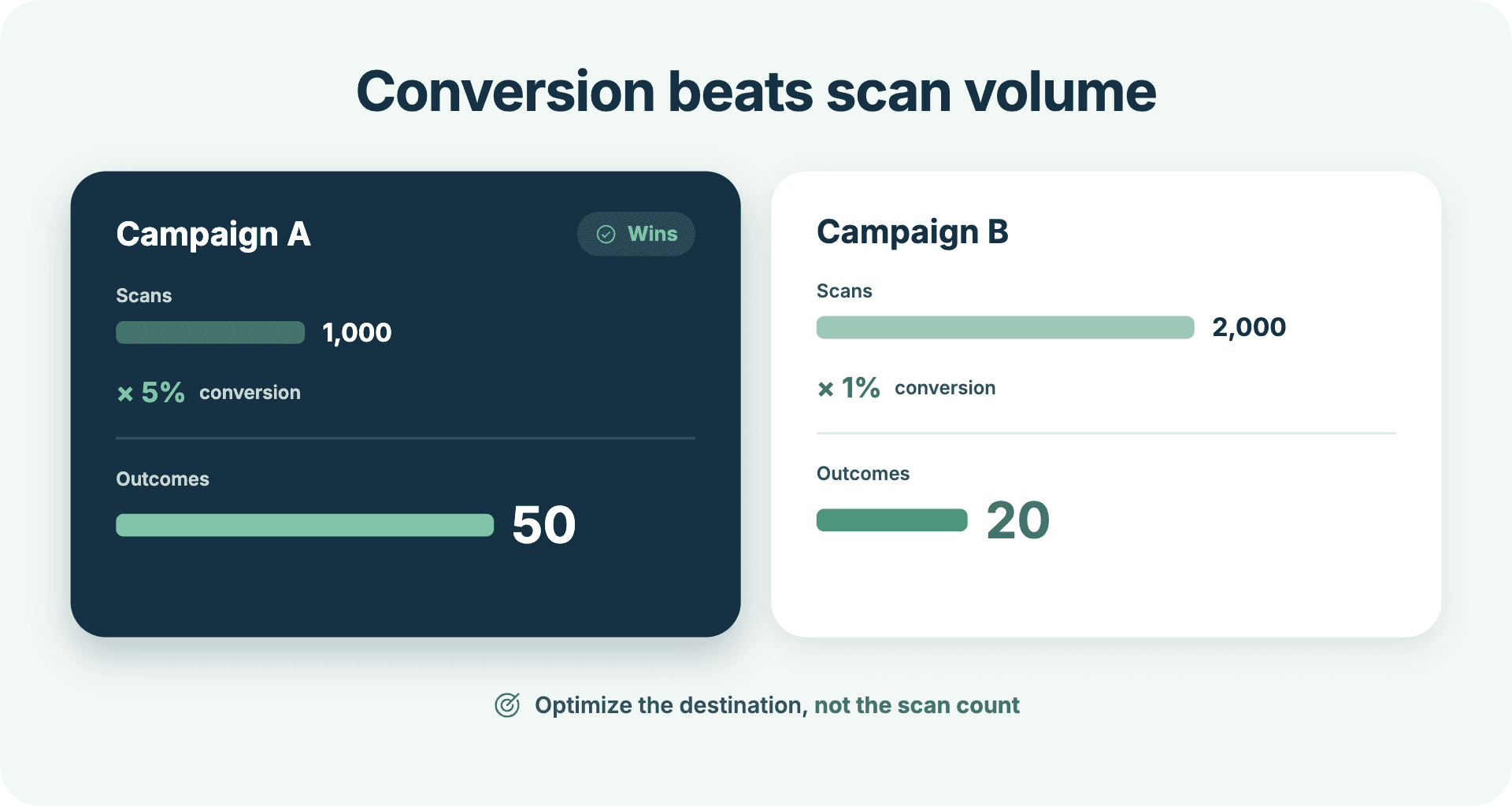
Conversion rate beats raw volume. A campaign with 1,000 scans at a 5% conversion rate produces 50 outcomes.
A campaign with 2,000 scans at 1% produces 20.
The bigger scan number loses.
Optimize the destination and the conversion rate, not the scan count.
Real campaigns, and what they teach
Two case studies bracket the range, from a small print-first business to a national rollout, followed by a few quick creative examples.
SMB: MDL Marinas
MDL Marinas, a traditional UK marina business with a print-heavy, older customer base, put QR codes in member welcome packs and captured 900 registrations in about three weeks (Target Internet). Two lessons stand out.
Making the codes "front and centre" rather than hidden in the design lifted response by 20 to 30%.
And uptake was even across age groups, even though most customers were over 55. Prominence and an easy post-scan journey beat clever design, and QR is not just for younger audiences.
Scale and attribution: Albertsons and Fetch
Albertsons put a QR code on every receipt across more than 2,000 stores and used deep linking to attribute over a million app users in two months (AppsFlyer).
Fetch's Super Bowl QR drove 1.3 million new accounts at an 81.33% scan-to-install rate (AppsFlyer).

Both pair a real incentive with a frictionless scan-to-action path, and both, importantly, measured the outcome rather than just the scan. Both figures are partly vendor-reported, so read them as reported.
Quick creative examples
Coca-Cola used artistic Coke Studio codes that opened a music video. 19
Crimes put augmented reality on wine labels so the character on the bottle tells their story.
McDonald's linked packaging to nutrition info and, separately, to anime content. Miller
Lite ran a wearable "Running of the Beers" QR giveaway instead of a TV ad.
The pattern across every winner is a clear value exchange. People scan because something worthwhile waits on the other side. A homepage is a wasted scan.
Common mistakes (and when not to use a QR code)
Most QR guides are relentlessly upbeat. Credibility comes from naming the ways campaigns fail.
The recurring mistakes are predictable:
Using static codes for print, so you cannot fix a dead URL or track anything
Skipping UTMs, so traffic lands in
directand cannot be recovered laterSending people to a homepage or a slow, non-mobile page
Pairing the code with a weak CTA or none
Printing the code too small or without a quiet zone
Placing it on a glossy surface, a moving object, or a low-signal spot
Measuring only scans, or only the first week
When a QR code is the wrong tool
In email and in-feed social, use a link, because integrating qr codes into those digital placements often adds friction instead of value. The person is already holding the device that would scan. On a 65-mph billboard, do not expect scans.
And if you cannot make the destination fast, mobile-first, and worth the tap, fix that before you print anything. A QR code amplifies a good destination. It cannot rescue a bad one, because qr codes offer the most value when they bridge the physical world to the digital world, not when they duplicate an existing clickable path.
A note on trust
QR phishing, nicknamed "quishing," has risen sharply, with QR codes appearing in roughly 12% of phishing attacks in 2025, and most people scan without checking the URL first.
A branded custom domain on your codes signals legitimacy and is one reason to avoid generic shared shorteners on physical assets, especially in physical spaces where trusted branding can improve brand credibility. ShortPen supports custom domains on every plan, and the free plan includes one.
FAQ
Do QR codes still work for marketing in 2026?
Yes. Adoption and scan volume are still climbing, with 102.6 million US scanners projected for 2026 and 98% of marketers reporting a positive impact. They also enable seamless connections between physical and digital experiences, which is why they remain a versatile marketing tool across campaigns. The lever is no longer whether people scan. It is how well you use the scan, from the destination you send them to through to the conversion you measure.
Static vs dynamic QR codes, which should I use for marketing?
Use dynamic. Dynamic codes let you edit the destination after printing, record scan analytics, and A/B test landing pages. Static codes are fixed and untrackable, which only suits throwaway one-offs. You cannot convert a static code to dynamic later, so choose dynamic from the start. A trackable QR code generator makes the dynamic setup straightforward.
How do I track whether a QR scan led to a signup or sale?
Use a dynamic code with a UTM-tagged destination for analytics, then add a pixel and event tracking to attribute the downstream conversion. In ShortPen, scans are tracked automatically, and conversions require installing the ShortPen Pixel and enabling event tracking on the link. From there, you can see scans flow through to signups or purchases per link and across a workspace.
Why do my QR scans show up as "direct" traffic in GA4?
Because the destination URL has no UTM parameters. Google Analytics 4 cannot tell the visit came from a QR code, so it files it under direct. Tag the URL with UTM parameters before you generate the code, and the scan traffic will appear under the source and medium you set.
How big should marketing QR codes be?
At least one tenth of the scanning distance, which is the 10:1 rule. For anything held in the hand, roughly 2cm by 2cm is the floor. Posters and signage viewed from further away need to scale up proportionally. When in doubt, size up, because an oversized code still scans while an undersized one fails.
Can I add my logo and brand colors without breaking the code?
Yes, within limits. Use error correction level H, keep the logo under about 20% of the code area and centered away from the corner squares, and maintain strong contrast. A qr code generator with branding controls also helps keep designs consistent across marketing materials. Always test the final code on several phones before printing, since heavy customization can push a code past what scanners can recover.
Should I put a QR code in an email?
Usually no. The reader is already on a phone or near a clickable link, so a plain link converts better. The one good exception is a deliberate desktop-to-mobile handoff, such as prompting someone reading on a laptop to scan and install your app.
Can I run a QR code campaign on a free plan?
Yes, for the essentials. ShortPen's free plan includes unlimited links and QR codes, unlimited clicks, one custom domain, and a monthly cap on tracked events. Advanced analytics, full API access, and webhooks sit on the paid plans, so you can start a real campaign for free and upgrade when you need automation or deeper reporting.
Conclusion
The strategy was never the code. It is the chain that runs from a single clear objective, to a scannable branded code, to a destination that matches the moment, to a conversion you can actually measure.
The teams that win treat the scan as the opening of the funnel and build everything else to carry that scan through to a result.
Pick one upcoming offline touchpoint, focus on adding QR codes where foot traffic and intent are strongest, and test one placement on retail shops, a coffee shop counter, or out of home signage with a single goal and a dynamic branded QR code.
You can start on ShortPen's free plan and see the full path from scan to signup before you spend a thing.
Ready to make every click count?
Simplify your link management, gain valuable insights, and take control of your online presence. Your journey to better links starts here.